
Partners & OCCAR
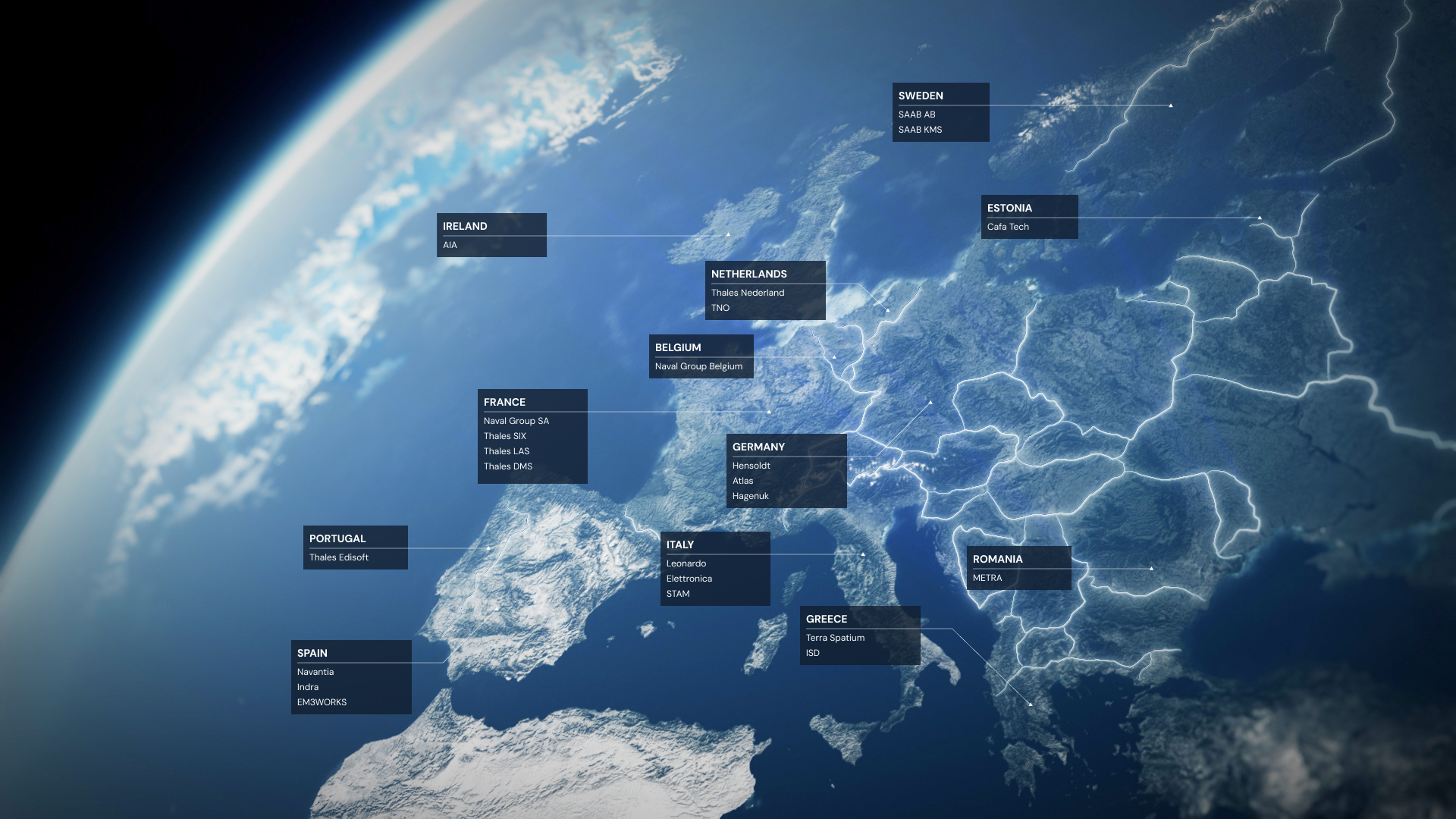
The E-NACSOS program is composed of 25 partners from 12 different countries (Belgium, Estonia, France, Germany, Greece, Ireland, Italy, Netherlands, Portugal, Romania, Spain, Sweden).

Applied Intelligence Analytics Ltd (AIA), a technology SME based in Ireland, specialises in developing AI-driven solutions for tactical, operational, and strategic decision support applications in the defence sector. Leveraging extensive expertise in artificial intelligence and machine learning, AIA provides innovative solutions in sensor data analytics, threat detection, hardware-accelerated AI model training, data fusion, text analysis, big data analytics, and edge-based AI-driven surveillance.
AIA will contribute to various technological topics of E-NACSOS, including interoperability, situational awareness, and implementation studies.

Atlas Elektronik is a German leader in the defence sector, supplying sonars, command and weapons deployment systems, mine warfare systems, unmanned underwater and surface vehicles, communication systems, underwater weapons as well as coastal surveillance and shipping guidance systems.
Atlas is mainly involved in the definition of the architecture and in the second increment of E-NACSOS.

CAFA Tech is an Estonian robotics and defence technology company that develops drones and robots and their charging stations since 2015. CAFA TECH’s core mission is to provide autonomous unmanned systems (UxV) to replace human work in hazardous and difficult working conditions.
As part of E-NACSOS, CAFA TECH is involved in all technical Work Packages.

Electromagnetic 3 Works S.L. (EM3WORKS) is a Spanish SME specialized in electromagnetic simulations, management of radar signature, infrared signature and electronic warfare systems and cybersecurity.
EM3WORKS is mainly involved in studies and design activities of E-NACSOS.

ELETTRONICA (ELT Group) is an Italian company operating in the defence sector, particularly in electronic warfare systems.
ELETTRONICA contributes to the methodology and the second increment of E-NACSOS project.

Hagenuk Marinekommunikation (Hagenuk) is a subsidiary of Atlas Elektronik with an expertise in the fields of hydroacoustics, sensor engineering and information technology.
Hagenuk is involved in the same activities as its parent company Atlas Elektronik.

Hensoldt AG is a German multinational corporation which focuses on sensor technologies for protection and surveillance missions in the defence, security and aerospace sectors.
Leader of the WP focused on Methodology (WP2), Hensoldt also works in the standard definition and the second increment.

INDRA is a multinational information technology and defence systems company based in Spain.
INDRA leads the WP3 of E-NACSOS, focusing on the advanced and derisking studies and contributes to every other technical Work Package.

Integrated Systems Development (ISD) is a Greek independent SME organisation which develops Integrated Systems in the Space and Defence sectors.
ISD contributes to all technical work packages of the project with emphasis on the data structure for tactical information exchange between various NCS nodes. Moreover, ISD will lead the implementation and validation of the NCS protocol stack on vessels of the Hellenic Navy.

Leonardo is a global company that develops multi-domain operational capabilities in the Aerospace, Defence and Security sectors, with an integrated offer of high-technology solutions for military and civil applications.
Leonardo contributes to all technical Work Packages of E-NACSOS with a significant involvement on the second increment as they lead WP10 (Design of Increment 2) and WP11 (Prototyping of Increment 2).
Military Equipment and Technologies Research Agency (METRA) is a Research and Technology Organization (RTO) which is part of the Ministry of National Defence of Romania. Its main mission is to perform fundamental oriented, applied scientific research and technological development to introduce the technical progress in the military field.
As part of E-NACSOS, METRA is involved in studies and design phases.

Naval Group is an international player and a European leader in naval defence. With a heritage of almost 400 years, Naval Group intervenes all along the value chain of naval ships and naval systems, from strategic programme planning to design, construction and management of operational readiness.
Leader in naval collaborative combat for French Navy, Naval Group is the Project Coordinator of E-NACSOS and is leading the four following Work Packages: WP1, Project management & coordination; WP5, Definition of the Naval Collaborative Surveillance capacity; WP12, Testing of the 2nd Increment; and WP13, Project outreach monitoring and exploitation & standardization activities.
Naval Group Belgium is the Belgian subsidiary of Naval Group, active in mine warfare and cybersecurity through its dedicated MCM and Cyber Laboratories.
Naval Group Belgium contributes to the concepts of operations, the definition of the standard but also to exploitation & standardization activities.
The Spanish shipbuilder Navantia, 100% owned by the Spanish Government, is a world reference in the design, construction and integration of state-of-the-art ships, as well as ship repairs & modernizations. It is also engaged in the design and manufacture of Integrated Platform Management Systems, Fire Control Systems, Command and Control systems, Propulsion Plants and through life support for all its products for any type of vessel: patrol boats, frigates, submarines, aircraft carriers, etc.
Navantia is leading WP6 (implementation of the standard within existing European systems) and is contributing to all technical work packages.

Saab is a Swedish company active worldwide and offering solutions from the depths of the oceans to the sky, on land and in cyberspace.
Saab contributes to every technical Work Package with a major involvement in the prototyping and testing phases of E-NACSOS as they lead WP9, corresponding to the testing of the first increment.
Saab Kockums (Saab KMS) is an affiliated entity of Saab, mainly building military corvettes and submarines.
Saab KMS is involved in every technical Work Package with a particular focus on the second increment phase.
STAM is an engineering and technology consulting company that provides support to clients facing new business and innovation challenges.
The main contribution of STAM to E-NACSOS will be in the field of modelling and simulation to support the incremental development of the Naval Collaborative Surveillance capability.

Terra Spatium is a Greek SME with a 30 years’ experience in the fields of remote sensing and geo-information.
Already involved in several European projects, Terra Spatium contributes to all technical Work Packages of E-NACSOS and works on scenarios for the Hellenic Navy.

Thales Defence Mission Systems (TDMS) is a European leader in the market for airborne and naval defence mission systems and equipment.
TDMS contributes to studies, NCS standard and both increments.
Thales EDISOFT is a Portuguese naval systems integrator and is involved in several projects worldwide.
Thales EDISOFT is represented in E-NACOS by their AWS unit, which will be involved in the pre-design studies, both increments phases but also the definition of the naval collaborative surveillance capacity.
Thales Land Air Systems (TLAS) has expertise in different fields such as integrated airspace protection systems, surface radars and optronics and missile electronics.
TLAS mainly contributes to studies, definition of the standard and both increment phases of E-NACSOS.
Thales Nederland (TNL) is a sensor and fire control system manufacturer and a system integrator for naval ships.
Thales Nederland is the Technical Coordinator of E-NACSOS, contributes to all Work Packages of the project and leads WP8 relative to the Prototyping of Increment 1.
Thales Secure communications & Information Systems (TSIX) is specialized in secure information and communication products and systems for armed and security forces.
As part of E-NACSOS, TSIX leads the Work Package 4 dedicated to Network Studies and contributes to the second increment of the standard.

TNO is a Dutch independent contract research organisation. Based on its expertise in technological, policy, business and social innovation, TNO translates scientific knowledge into practical applications and contributes to the innovation capacity of businesses and government. TNO Defence, Safety & Security (DSS) is one of six units and is a strategic innovation partner of the Dutch Ministry of Defence and the Ministry of Justice & Security, including the National Police.
TNO contributes to all technical work packages of E-NACSOS and is the leader of WP7 which is the design of increment 1.
OCCAR
(Organisation Conjointe de Coopération en matière d’Armement / Organisation for Joint Armament Co-operation) is an international organisation whose core-business is the through life management of complex, cooperative defence equipment programmes. The current OCCAR Member States are: Belgium, France, Germany, Italy, Spain and the United Kingdom.